London, U.K. Queen Elizabeth II, the longest-reigning British monarch whose rule spanned seven decades, died on Thursday, September 8, 2022, at the age of 96, Buckingham Palace has announced.
(Full Story)
|
By Helit Barel
The Russian invasion of Ukraine and the nuclear context provided by President Putin, who has elevated the nuclear alert of his forces, immediately returned the subject of nuclear deterrence to the agenda. Will the nuclear taboo be broken for the first time in 77 years, or will the balance of nuclear deterrence be maintained? The real risk involves the tactical weapons, and even there, the likelihood of use is low, despite fears that the Putin’s calculation of profits and losses will lead him to escalate the campaign.
(Full Story)
|
By Eldad Shavit, Zvi Magen and Shimon Stein
Israel has decided to side with the US and the West in condemning the Russian aggression at the upcoming General Assembly debate.
*****
War is raging on Ukrainian soil, but the Russian forces have thus far failed to surround and isolate Kiev, the Ukrainian capital. The United States, Great Britain, and the European Union are fully coordinating their response, with a focus on three areas: economic and political isolation of Russia; the supply of military aid to Ukraine; and stepped-up military preparations among NATO countries.
(Full Story)
|
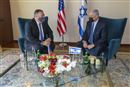
Netanyahu - Pompeo meeting Nov. 2020 US State Department By Shlomo Brom and Shimon Stein
Beyond the political issues surrounding the assassination of the “father of the Iranian bomb,” there are also questions regarding the action’s necessity and value. Will it slow down Iran’s nuclear program to a significant degree? Was it worth the angry reactions throughout the world and the revenge that is expected from the Islamic Republic? Consider these questions from a “less popular” perspective
(Full Story)
|
By Eyal Propper
In the four years of the Trump presidency, China-US relations reached a boiling point. Beijing understands that with a new administration in Washington, while the competition will not disappear, the superpower rivalry will present differently. How will the Chinese Communist Party respond to the Biden presidency?
(Full Story)
|
By Shahar Eilam and Michal Hatuel-Radoshitzky
A comparative analysis enables us to examine different approaches to the challenges posed by the corona pandemic around the world. Most countries have adopted a similar coping strategy, based on three components: the first is a lockdown policy (to varying degrees), in an attempt to slow the spread of the virus and avoid overloading the health system; the second is the improvement of preparedness and readiness in health systems; and the third is a broad economic aid package in response to the sudden economic shutdown and the deep financial crisis.
(Full Story)
|
By Doron Ella and Shira Efron
On January 15, 2020, the United States and China signed an interim agreement as a first phase toward a comprehensive deal that will end the trade war between the two countries. However, the actual achievement is questionable, since the key components of the agreement focus on at least partial elimination of the tariffs imposed during the trade war, while the American demand that China reduce its subsidies to state-owned Chinese enterprises – which give Chinese companies advantages over other companies – was left out of the agreement.
(Full Story)
|
By Orna Mizrahi
A popular protest erupted in Lebanon on October 17, 2019 on a scale unprecedented in recent years. Mass demonstrations grew steadily stronger in successive days, and have so far numbered between tens of thousands and hundreds of thousands of participants as they spread from Beirut to the country's other principal cities. For now, the protests continue. The trigger for the demonstrations - in the sense of "the straw that broke the camel's back" - was an unusual decision (rescinded immediately, one day after the protest erupted) to tax WhatsApp voice calls.
(Full Story)
|
The second summit between US President Donald Trump and North Korean leader Kim Jong-un aimed to achieve the dismantlement of North Korea’s military nuclear infrastructure in return for sanctions relief, but ended abruptly, with no joint document or statement of the two leaders. Most likely the Hanoi experience does not portend derailment of the US-North Korea process, at least for now, and both sides apparently still have an interest to continue cooperation. At the same time, the US and North Korea will find it extremely difficult to resolve a basic contradiction regarding denuclearization.
(Full Story)
|
The Khashoggi affair, which is far from over, poses the most significant challenge to US-Saudi relations since the 9/11 terrorist attacks in the United States. Thus far, the administration’s response reflects uncertainty and ambivalence, given its understanding that Riyadh’s conduct demands a response, versus its hope that it will not be forced to acknowledge the failure of its Middle East policy, which assigns Saudi Arabia a critical role, particularly in the efforts to contain Iran. The recent events have intensified the internal unrest that has marked the kingdom for some time, against the background of the confrontational conduct of Crown Prince Mohammad bin Salman.
(Full Story)
|